
Frequently Asked Questions
General Questions

Do you take insurance?
No, LifeTree Hypnotherapy & Breathwork does not file sessions with insurance companies.
Can I file sessions for reimbursement with my insurance company?
Some private insurance plans may partially reimburse services (typically 50–80%) when sessions address specific concerns such as anxiety, pain management, or smoking cessation. However, hypnotherapy is often bundled with psychotherapy services and is rarely covered as a standalone service.
We recommend contacting your insurance provider directly to ask about out-of-network reimbursement and eligibility.
Does hypnotherapy qualify for FSAs and/or HSAs?
Yes, hypnotherapy may qualify for reimbursement through Flexible Spending Accounts (FSA) or Health Savings Accounts (HSA).
Typically, this requires a Letter of Medical Necessity (LMN) from your doctor stating that sessions are recommended for a specific medical or mental health condition. Check with your plan administrator for details.
Do you see clients in person?
Yes. In-person sessions are available either:
- In my private office in Rowlett, TX
- In the comfort of your home (within the local service area)
Do you see clients virtually?
Yes. Virtual sessions are available via Zoom and allow me to work with clients anywhere in the United States and internationally.
Many clients love the flexibility and convenience of virtual sessions.
What does a virtual session look like?
We meet over Zoom in a secure video session. At the beginning of our time together, I’ll ensure you’re in a quiet, comfortable, and private space.
Hypnosis and breathwork are just as effective virtually — and in many cases, even more powerful — because you’re already in a familiar, safe environment. All you need is a stable internet connection and a comfortable place to relax.
Do you offer group sessions?
Yes. Private group sessions are available for both hypnotherapy and breathwork.
Group sessions are ideal for:
- Corporate wellness events
- Retreats
- Friend or family groups
- Healing circles
- Community experiences
If you're interested in hosting a private group experience, please reach out for details and availability.
Hypnotherapy Questions
What Is Hypnosis
Hypnosis is a completely natural state. In fact, we all go in and out of hypnosis throughout the day. Have you ever been driving and missed your exit on the freeway? Or, been deeply absorbed in a movie and forgot you are actually in a room full of strangers watching a projected image of actors on screen? Perhaps you’ve zoned out and daydreamed while someone was talking to you. All of these are all examples of being in a state of hypnosis.
What hypnosis is NOT
When most people hear the word “hypnosis” they think of swinging watches and the hypnotists telling someone to bark like a dog or cluck like a chicken on command. While that kind of hypnosis does exist, it is for the sole purposes of entertainment that you would find on the stages of a Las Vegas show.
This is very different from clinical hypnotherapy. You are completely alert and in full control of your mind and body while in the hypnotic state. You can hear, speak, and even walk around. Your body is relaxed and comfortable. You will never be asked to disclose any secrets or do anything you do not want to do. I use hypnosis strictly as a healing tool.
Does hypnotherapy really work?
Absolutely. In recent years hypnosis and hypnotherapy has become an accepted medical treatment to address a wide variety of issues and conditions. Researchers and professors in universities such as Stanford, Harvard, and Penn State, just to name a few, have conducted clinical studies in hypnosis and found that hypnosis does in fact alter the brain and can be used for a multitude of conditions. I have been extremely successful in using hypnotherapy to help our clients with a multitude of issues including improving self confidence, helping them to stop smoking, achieving significant weight loss, reducing or even eliminating anxiety. Hypnotherapy is an extremely powerful and effective tool and it’s results are long lasting.
How does hypnotherapy work?
When you are in a hypnotic state, your conscious mind has been relaxed. This allows the hypnotherapist to work directly with your subconscious mind. The subconscious mind holds all of our “programming”, much like a computer. You can “know” in your conscious mind that you want to make a change and be determined to make that change, but if your”computer is programmed” to keep doing what you are doing it will be nearly impossible to make lasting change unless you change the programming. That’s precisely what hypnotherapy will accomplish. When you change the subconscious programming the behavior follows.
Will Hypnotherapy work for my specific issue?
There is a very high likelihood that hypnotherapy will work for your issue. It is almost impossible to list ALL the possible uses of hypnotherapy but here is a very complete list of the issue we would be happy to assist you with.
What does hypnosis feel like?
Hypnosis is a very comfortable, peaceful and pleasant feeling. Your body is extremely relaxed but your mind is aware. You will feel a sense of rejuvenation and feel refreshed after a hypnotherapy session.
Will I lose control of myself?
Absolutely not! Hypnotherapy is a way of giving you more control, not less. You cannot be hypnotized unwillingly, and you cannot be prompted to do something that is outside of your moral code or say or reveal anything you do not want to.
Can I get stuck in hypnosis?
No, you are able to come out of hypnosis any time you wish. You can no more get “stuck” in hypnosis than you can get “stuck” awake or “stuck” asleep. … For practical reasons, as hypnotherapists we do explicitly end our clients’ trances, but if we didn’t the clients would naturally either return to full alertness or fall asleep.
What happens in the first hypnotherapy session?
The first session is the longest one at 70-90 minutes and consists of the following 4 main components:
- In depth consultation to understand what specific challenges you are currently dealing with, what you feel the blocks are (if known), and what your desired outcome is from our hypnotherapy sessions together.
- Detailed description of how hypnotherapy works in the human mind for your specific issue, and what you should expect to feel and experience while in hypnosis.
- Suggestibility Testing – In order to best create the most significant and powerful changes in mental programming, it is of the utmost importance to understand how you personally take in suggestions and information. This testing allows us to know exactly what type of hypnotic suggestions can make the most impactful positive changes in your subconscious mind.
- The last part of the first session is the hypnotherapy itself in which your subconscious programming will begin to change.
9D Breathwork Questions
What might I feel during a session?
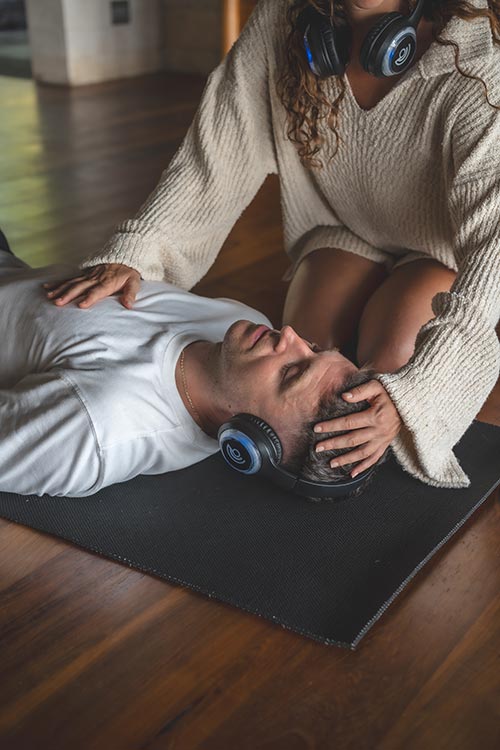
Experiences vary widely. Some people feel deep relaxation and calm, while others may experience emotional release, tingling sensations in the body, or moments of clarity and insight. These responses are normal and part of how the body processes stress and stored tension.
How long is a 9D Breathwork session?
Most sessions last 45 to 60 minutes, followed by a short integration period to allow your body and mind to settle.
Is 9D Breathwork similar to hypnosis?
While breathwork and hypnosis are different modalities, 9D Breathwork incorporates elements of guided subconscious work similar to hypnosis, allowing participants to access deeper mental states where emotional patterns and beliefs can shift.
Can 9D Breathwork help with anxiety and stress?
Breathwork practices are widely used to activate the parasympathetic nervous system, which helps the body move out of fight-or-flight and into a state of relaxation and regulation. Many participants report feeling calmer and more centered after sessions.
Is 9D Breathwork available virtually?
Yes. 9D Breathwork sessions can be experienced both in person and virtually. Virtual sessions require a quiet space, comfortable place to lie down, and quality headphones to fully experience the immersive audio design.
How should I prepare for a session?
For the best experience:
- Avoid heavy meals for 1–2 hours beforehand
- Wear comfortable clothing
- Bring water and a blanket if attending in person
- Use quality headphones for virtual sessions
- Come with an open mind and willingness to relax into the experience
How often should I do 9D Breathwork?
Some people attend sessions monthly for nervous system maintenance, while others participate more frequently when working through emotional or personal growth goals.
What is the science behind breathwork?
Breathwork techniques influence the autonomic nervous system, which regulates the body’s stress response. Specific breathing patterns can stimulate the parasympathetic nervous system, helping shift the body out of chronic fight-or-flight and into a state of calm and regulation. Research shows that controlled breathing can support stress reduction, emotional regulation, improved oxygenation, and enhanced mind-body awareness.
Can breathwork help release stored trauma or emotional tension?
Breathwork can help the body process stored stress and emotional tension by activating the nervous system and allowing suppressed emotions to surface safely. Because emotional experiences are often stored in the body, intentional breathing patterns may facilitate physical and emotional release, leading to increased clarity, relaxation, and emotional balance.
Breathwork is not a substitute for medical or psychological treatment but can be a powerful complementary practice.
Where can I experience 9D Breathwork in the Dallas / DFW area?
9D Breathwork sessions are offered through LifeTree Hypnotherapy & Breathwork in the Dallas–Fort Worth metroplex, as well as through virtual sessions for clients who prefer to participate from home. Both formats provide a guided, immersive breathwork experience designed to help regulate the nervous system and support emotional well-being.
Can breathwork be combined with hypnotherapy?
Yes. Breathwork and hypnotherapy work well together because both practices help access the subconscious mind and regulate the nervous system. Breathwork can help release emotional tension stored in the body, while hypnotherapy can help shift underlying beliefs, patterns, and subconscious responses. Many clients find that combining the two approaches creates deeper and longer-lasting transformation.